Over the past decade, the concept of the “smart home” has transitioned from a niche, futuristic novelty to a standard expectation in modern real estate. We have successfully automated our thermostats to learn our daily routines, our lighting to match our circadian rhythms, and our security systems to arm themselves when we leave the driveway.
Yet, when we look at the centerpiece of the living room—the entertainment system—there is often a disconnect.
For many households, the television remains a siloed device. It might be branded as a “Smart TV” because it has built-in streaming apps, but it rarely talks to the rest of the house. It is simply a glowing rectangle that demands manual input. However, a new wave of living room design is changing this narrative. By moving away from traditional flat panels and embracing advanced projection technology, homeowners are finally integrating cinematic, large-scale entertainment into their centralized home automation ecosystems.
Beyond the “Smart” TV
The fundamental limitation of the traditional smart TV is that its “smart” features are entirely inward-facing. The processor inside the television is dedicated to navigating its own proprietary menus and serving you advertisements. It does not know that the afternoon sun is creating a glare on the screen, nor does it care that you left the kitchen lights on at full brightness.
True home automation relies on an ecosystem—devices communicating via platforms like Control4, Savant, or even accessible consumer hubs like Apple HomeKit and Amazon Alexa. To achieve a truly integrated entertainment space, the display needs to act as an obedient, highly capable node within this broader network.
This is where the shift toward projection becomes a massive advantage for tech-savvy homeowners. A modern 4k laser projector is increasingly designed with robust integration protocols. Rather than trying to be the single source of all your streaming apps, these high-end units focus on being the ultimate display engine, leaving the computing to dedicated smart hubs and home automation servers.
The Magic of the “Movie Mode” Macro
The true value of integrating your display into a smart ecosystem is the ability to utilize “macros” or “routines.” A macro is a single command that triggers a synchronized cascade of events across multiple devices.
Imagine hosting a movie night. Without automation, the process is a chore: you walk around the room pulling down shades, search for the light switch to dim the overheads, hunt for the soundbar remote to adjust the volume, and finally power on the display.
In a fully integrated smart living room, the experience is entirely different. You simply say a voice command or press a single “Movie Time” button on a centralized keypad. Instantly, the network goes to work. The motorized window blinds silently descend to block out the streetlights. The overhead LED lighting fades down to a warm, two-percent glow. The AV receiver powers on, automatically switching to the correct HDMI input for your media server.
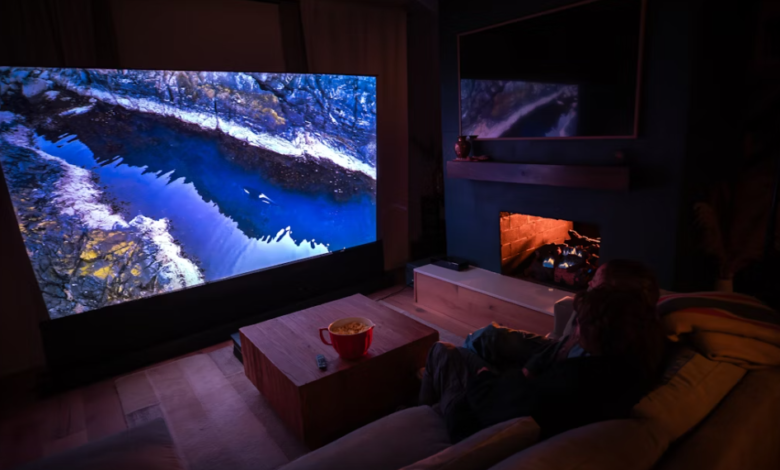
Simultaneously, your home projector powers up instantly—thanks to solid-state laser technology that requires no warm-up time. Through a simple 12-volt trigger connection or IP control, the projector sends a signal to your motorized floor-rising screen, which ascends from a hidden cabinet to meet the light beam. Within ten seconds, your bright, airy living room has autonomously transformed into a private cinema.
IP Control and 12-Volt Triggers: The Technical Handshake
How does this seamless communication actually work? High-quality projection systems achieve this through several standardized connections that traditional TVs often lack or implement poorly.
The most common and reliable method for local AV synchronization is the 12V trigger. This is a simple, physical cable connection between the projector and peripheral devices, like a motorized screen or mechanized blackout curtains. The moment the projector turns on, it sends a low-voltage electrical pulse through the cable, telling the receiving device to deploy. When the projector turns off, the signal drops, and the screen retracts. It is foolproof and requires no complex network programming.
For more advanced, whole-home automation, IP (Internet Protocol) control and RS-232 serial connections are utilized. These allow a central smart home brain to send granular commands to the projector over the local network. A smart home system can monitor the projector’s power state, adjust picture modes based on the time of day, or even power down the unit automatically if the home’s security system is set to “Away” mode, ensuring no energy is wasted.
The Aesthetic Automation
Integrating big-screen tech into a smart home isn’t just about convenience; it is a powerful interior design tool. Home automation is largely about hiding technology until it is needed.
A 100-inch television is impossible to hide. It is a permanent architectural feature of the room. Conversely, a projection setup combined with smart automation is inherently stealthy. Ultra Short Throw units can be housed in custom media cabinets equipped with motorized sliding tops. Linked to the smart home network, the cabinet only opens to reveal the lens when the system is activated.
This means the living room retains its architectural integrity, free from dominating black screens and visible hardware, while still housing a massive, theater-grade display ready to deploy at a moment’s notice.
See also: Growth Signal 8339140595 Expansion Alert
Conclusion: The Connected Cinema
As our homes become smarter, our expectations for how we interact with our living spaces must evolve. Entertainment should no longer be a disconnected, manual experience that interrupts the flow of a modern, automated house.
By treating your massive cinematic display not as a standalone appliance, but as a collaborative component of your smart home network, you elevate the act of watching a movie. It stops being just screen time and becomes a fully automated, multi-sensory environment.